
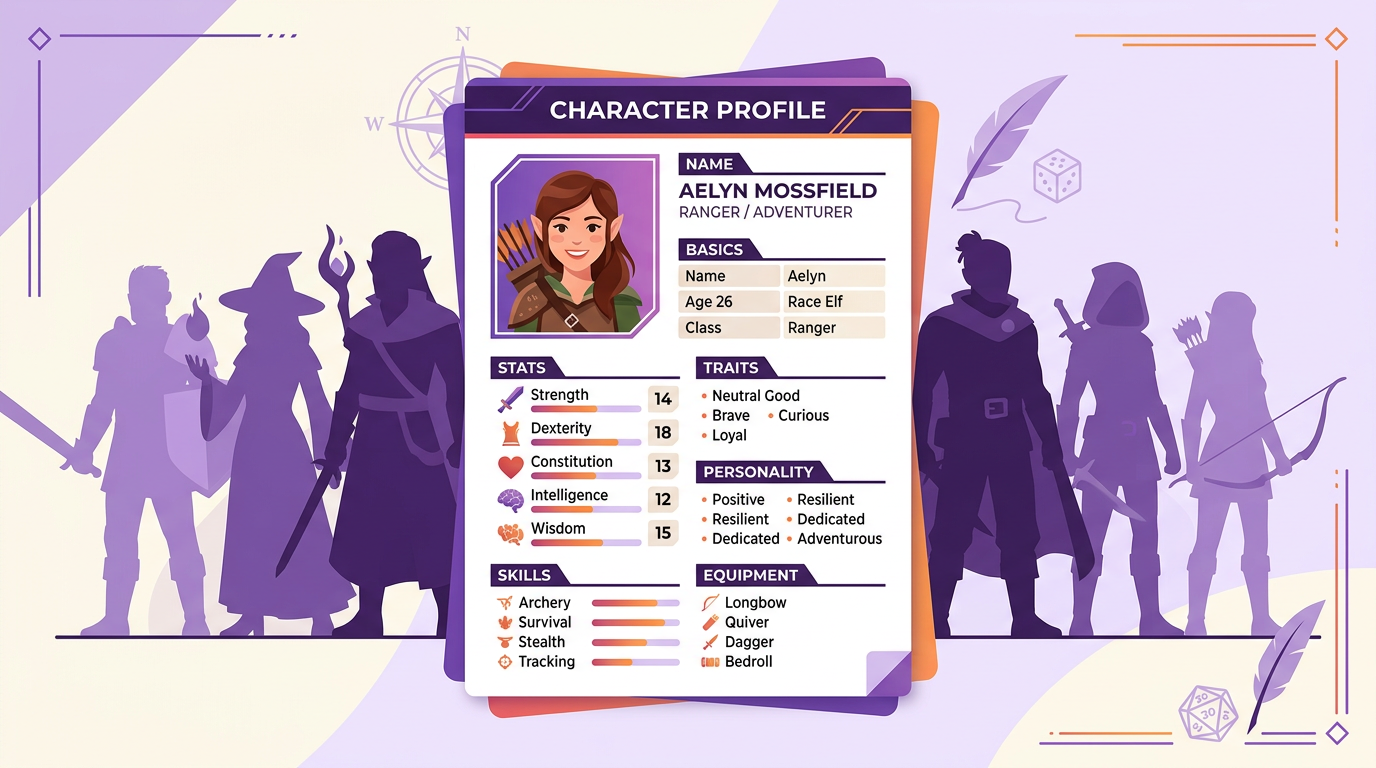
A character profile is a working reference for decisions you need to remember while writing. It should help you answer “What would this person do under pressure?” A profile that only records appearance, favorites, and labels may be fun to complete but will not reliably guide a scene.
Start with the story-facing core
- Role: what the character does in the story and in daily life.
- External goal: the concrete result they are pursuing now.
- Internal need: the change they resist but the story will pressure.
- Working belief: the rule they think keeps them safe or effective.
- Contradiction: where a strength and a limitation come from the same strategy.
Worked profile: Mara Vale
Role: licensed courier between floating settlements. Goal: prove her missing brother reached the northern route. Belief: reliability requires personal control. Contradiction: her preparation saves lives, but her refusal to delegate makes larger missions impossible.
Voice and behavior
Mara describes emotion as distance, timing, weight, or route risk. When afraid, she becomes more precise rather than louder. She checks message seals twice and avoids promises about arrival times.
Relationships
Iven, a portal engineer, challenges her belief that evidence must come before trust. Tali, a younger courier, copies Mara’s independence and exposes the harm hidden inside an admired strength.
Continuity anchors
- Carries a repaired green coat and a dented brass compass.
- Uses portals only when someone else controls the record.
- Will break a regulation to deliver a message, but not alter its words.
Separate stable facts from scene state
Stable facts belong in the profile: voice pattern, skills, values, established history, and visual anchors. Temporary injuries, current secrets, relationship changes, and chapter-specific goals should be updated as the story progresses or tracked in the relevant arc.
Add skill evidence and limits
Do not write only “expert courier” or assign a numeric skill score. Record how the skill was learned, what task demonstrates it, what conditions reduce it, and what the character incorrectly assumes the skill can solve. Mara reads wind and route wear well, but her expertise makes her underestimate political manipulation because she expects danger to leave physical evidence.
Record knowledge separately from truth
A profile often mixes what the writer knows with what the character knows. Keep a short section for beliefs, secrets, false assumptions, and information sources. This prevents a character from acting on facts they never learned and gives revelations a clear place in the project.
Leave low-value fields blank
Do not invent favorite foods, birthdays, measurements, or personality labels unless they matter to characterization, continuity, or your creative format. A shorter profile that predicts behavior is more valuable than a complete template filled with guesses.
Profile review checklist
- Can you identify a choice only this character would make?
- Does every major skill have a limit or cost?
- Do relationships reveal different sides rather than repeat the same praise?
- Can you distinguish fact, interpretation, and planned future change?
- After a major story event, which profile fields must be updated?
Update the profile without erasing history
When the character changes, keep the original belief and mark the event that revised it. This lets you write earlier scenes consistently and understand why a new behavior matters. For long projects, include a “current state” section rather than rewriting the entire profile after every chapter.
A profile should be easy to scan during drafting. Put the core, current goal, active relationships, and continuity anchors first. Store exploratory questionnaires and unused alternatives below them or in a separate note.
Continue with the Original Character Design Guide or use OC Studio to connect the profile to world, relationship, and arc records.