
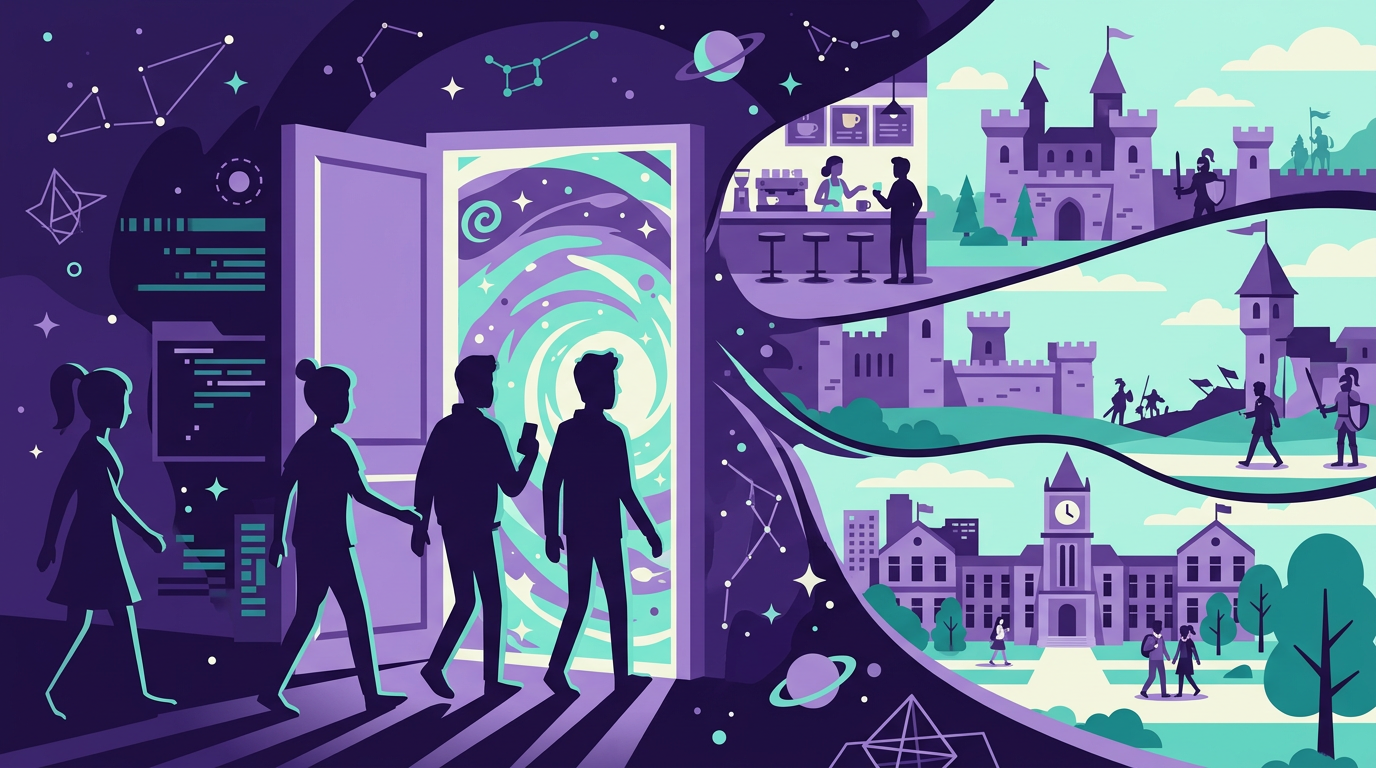
If regular headcanons ask 'what happens between the scenes,' AU headcanons ask something more radical: 'who is this character when everything is different?' Alternate Universe fan creativity is about finding the essential core of a character — the thing that's still recognizably them even in a coffee shop in modern Seattle, or a medieval kingdom, or a parallel world where they made a different choice at the critical moment.
What Are AU Headcanons?
AU stands for Alternate Universe. An AU headcanon places characters from one story into a fundamentally different setting or starting condition. The characters retain their essential personalities, dynamics, and relationships — but the world around them is changed.
The creative question is always the same: without the specific plot events that shaped them, who are these people? What parts of them are essential, and what parts were circumstantial?
Common AU Types in Fandom
Coffeeshop AU
The most famous AU in fandom. Characters are placed in a modern, mundane setting — usually one works at a coffee shop and one is a regular. The appeal is simplicity: no superpowers, no world-ending stakes, just two people learning each other through small rituals.
What makes a good coffeeshop AU: the characters still act like themselves. A warrior character is still a warrior — they're territorial about their table, they have opinions about coffee that are disproportionately strong, they're the first to react when something falls.
College AU
Characters meet in university — dorm neighbors, class rivals, thesis partners, sports teammates. College AUs are popular because they create a natural context for slow-burn relationship development: long-term proximity, shared pressure, and clear social stakes.
- What's their major? This reveals character values — someone who fights for others in canon might study law or medicine
- Dorm vs. apartment: living arrangements drive the domestic headcanon content
- How do their canon group dynamics translate to a study group or friend circle?
Soulmate AU
A soulmate AU introduces a worldbuilding mechanism — matching marks, first words tattooed on skin, seeing in color only when you meet your soulmate — that forces the character dynamic into a new framework.
Soulmate AUs are meta-commentary on the ship: they ask what it would look like if the universe itself confirmed what fans believe about these two characters. The best soulmate AUs use the mechanism to explore, not just affirm — what if the soulmate mark is a source of conflict, not just destiny?
Canon Divergence AU
A Canon Divergence AU is not a full alternate universe — it's a fork in the road. Something happens differently, and the writer follows where that difference leads. What if a character survived? What if they made the other choice at the critical moment? What if two characters met earlier, or later, or in the wrong order?
Canon divergence is popular because it stays close to the emotional truth of the source material while asking 'what could have been different?' It is headcanon as grief and wish fulfillment simultaneously.
Dark AU and Mirror Universe
Dark AUs ask: what if everything went wrong? What if the hero became the villain? What if a supporting character had different circumstances — more love, more neglect, more trauma? Dark AUs explore the fragility of the 'good' version of a character — how thin is the line between who they are and who they could have been?
Historical and Fantasy Setting AUs
Placing modern characters in medieval settings, Regency-era society, ancient mythology, or near-future sci-fi strips away the contemporary context and shows what remains. These AUs are often the most artistically ambitious: they require the writer to understand what roles their characters would occupy in a different social structure.
How to Write an AU Headcanon That Works
The most common failure in AU writing is treating the AU setting as a costume and the character as a generic protagonist who wears it. The setting is context — but the character is the point.
- Start with character essence: List three to five traits that are irreducibly this character. Not job or power or circumstance — personality, patterns, values.
- Let the AU setting pressure those traits: How does each trait express differently in this new context? What does it cost them? What does it give them?
- Preserve the core relationship dynamic: If two characters are rivals in canon, find the rivalry in the new setting. If they're found family, find the found family.
- Use the AU to say something: The best AUs aren't just 'what if they were baristas' — they use that setting to explore something about the characters that the original setting made harder to see.
Generating AU Headcanons with AI
The scenario headcanon generator on Headcanon.io lets you drop characters into specific situations, including AU premises. Try entering your characters with an AU context — 'Deku and Bakugo, college AU, roommates' — to generate grounded, character-specific content to build from.
For full AU world-building, the Story Project feature lets you store your AU's rules, characters, and world-building in one place — so the creative details stay consistent as your AU expands.
Frequently Asked Questions
What does AU mean in fandom?
AU stands for Alternate Universe. In fandom, it refers to fan-created stories or headcanons where characters are placed in a fundamentally different setting, premise, or starting condition than the original source material.
Which AU type should I choose?
The coffeeshop AU is the single most referenced AU format across fandom, famous enough to have become a genre joke. College AUs and soulmate AUs are close second and third.
Can AU headcanons include characters from different fandoms?
Yes — crossover AUs that place characters from different source materials into the same world are a distinct and popular format, particularly on AO3 where crossovers are well-organized.