
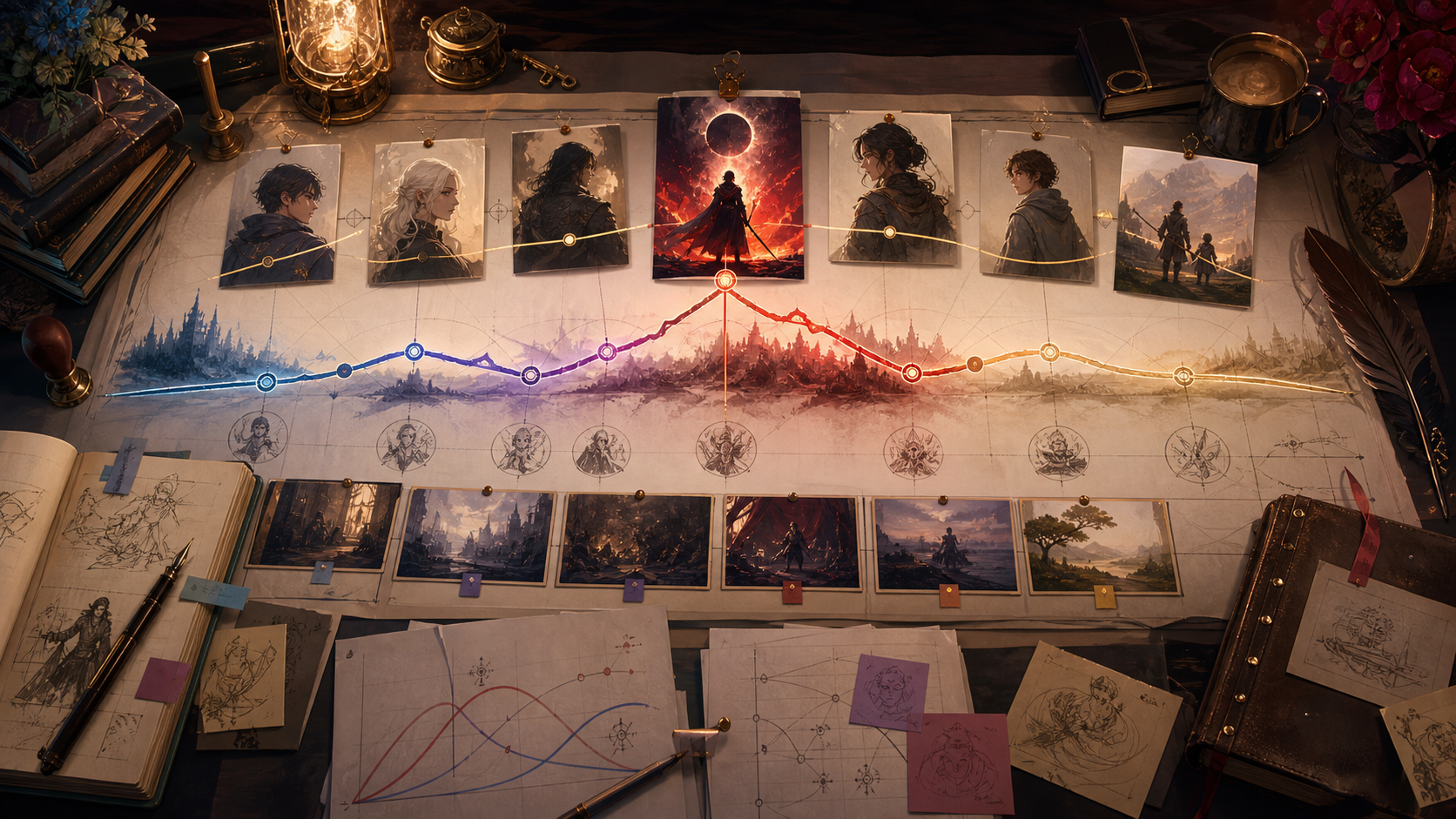
An interactive story is not simply a story divided by buttons. It is a sequence of decisions in which the reader can understand the situation, choose an intention, and see the story respond. To make one work, you need a character who wants something, an obstacle that can change, and choices that reveal what the player values.
This guide shows how to move from a blank page to a playable opening. You can use the method for interactive fiction, a branching fan story, an original-character adventure, or a story game with choices. No coding is required for the writing process.
The three parts of a strong interactive story
Before outlining branches, establish three connected elements:
- A playable character with an immediate goal. The player needs to know who they are in the scene and what they are trying to protect, learn, escape, repair, or obtain.
- A situation that will not remain neutral. A deadline, secret, rival, broken promise, or approaching danger creates pressure to act.
- A decision with more than one reasonable intention. The alternatives should express different priorities—not one intelligent answer beside two obvious mistakes.
These elements form the story engine. Setting, lore, and character history matter when they change that engine. Details that do not affect a decision can wait until the reader needs them.
How to make an interactive story in seven steps
1. Define the player’s role
Write one sentence that identifies the player character and the kind of control the player has. “You are Mara, an apprentice cartographer trying to recover a stolen map” is more playable than “This is a fantasy story about a map.” The first version gives the reader an identity and a purpose.
If you are writing with an original character, note two stable traits and one contradiction. Mara may be meticulous and loyal, yet willing to lie when her mentor is threatened. The contradiction creates decisions that cannot be solved by following one trait every time.
2. Write a premise that already contains pressure
A useful premise answers four questions: who is present, where are they, what just changed, and what could be lost? You do not need a full plot summary.
“You are Mara, an apprentice cartographer. At the border bridge, a guard produces the map you thought was stolen and accuses your missing mentor of selling routes to the enemy. The bridge closes at sunset.”
The example supplies a role, a location, a revelation, and a deadline. It also leaves room for several explanations, so the player can investigate instead of following a predetermined conclusion.
3. Decide what must remain true
Continuity becomes harder when every new scene can quietly rewrite the old ones. Create a short canon list before play begins. Include only facts that later choices must respect:
- Mara has never crossed the border.
- Her mentor disappeared three nights ago.
- The map contains a route that should not exist.
- Mara wants to believe her mentor is innocent, but she has no proof.
Separate facts from suspicions. “The mentor is a traitor” closes the mystery; “the guard claims the mentor is a traitor” creates a question. This distinction is especially important when an AI system helps continue the story.
4. Design choices around intentions
A choice becomes meaningful when each option pursues a different goal or accepts a different risk. For the bridge scene, three useful directions might be:
- Protect the relationship: defend the mentor and challenge the guard’s evidence.
- Seek information: pretend to cooperate so the guard reveals where the map came from.
- Protect the mission: steal the map and run before the bridge closes.
All three choices can move the story forward. They differ in loyalty, honesty, and risk. Avoid options such as “ask what happened,” “ask for more information,” and “question the guard”; those are surface variations of the same intention.
5. Make consequences visible
The next scene should acknowledge what the player chose. A consequence can change access, trust, knowledge, danger, or time. It does not always need to be a punishment.
If Mara pretends to cooperate, the guard may disclose a witness but become more suspicious of her questions. The player gains information and creates a social cost. Showing both effects makes the choice feel recorded rather than decorative.
6. Rejoin branches when the dramatic question is shared
You do not need to write an entirely separate novel after every choice. Let paths diverge long enough to produce a distinct consequence, then bring them toward a shared pressure point. Mara might reach the closed customs house by persuasion, stealth, or pursuit; the method changes who trusts her and what evidence she carries.
This “branch and fold” structure controls complexity while preserving agency. Keep separate state for consequences that should matter later, such as whether the guard was deceived or whether the map was damaged.
7. Test the first three turns
Play the opening as three different readers: one cautious, one confrontational, and one curious. After each short test, ask:
- Did the scene make the immediate problem clear?
- Could the player tell how the options differed?
- Did the response acknowledge the chosen intention?
- Did any new fact contradict the canon list?
- Would the player know what to do next without an author explanation?
Fix confusion in the opening before expanding the outline. Three responsive turns are a better foundation than thirty branches built on an unclear premise.
A simple interactive story outline
Use this compact structure when you want to plan before writing scenes:
- Opening disruption: something changes before the protagonist can prepare.
- First commitment: the player chooses a method, ally, or priority.
- Complication: the chosen approach works partly and exposes a new cost.
- Reversal: new information changes what the original problem means.
- Final decision: the player chooses what to sacrifice, protect, or believe.
- Ending state: the outcome reflects both the final decision and one or two earlier consequences.
For a short story, each item may be one scene. For a longer story, treat each as a chapter made of several decisions. The structure gives the story direction without requiring every line to be planned in advance.
If the choices should change the protagonist over time, use the story arcs guide to connect pressure, consequence, and character change across a longer project.
How to preserve character voice and continuity
Interactive stories often drift because the writer tracks events but not character logic. Keep a small continuity record with four categories:
- Stable facts: identity, abilities, world rules, and established history.
- Current state: location, injuries, possessions, active dangers, and time pressure.
- Relationship state: trust, suspicion, debt, affection, or rivalry created by play.
- Open questions: mysteries and promises that still need an answer.
For voice, give each important character a conversational pattern and a boundary. A guard may answer direct questions with procedural language but become personal when loyalty is mentioned. That is more useful than a long list of adjectives because it guides actual dialogue.
If you need to develop the protagonist first, use a character headcanon generator to explore motives and habits, then keep only the details that affect this story. For a conflict driven by two people, the relationship headcanon generator can help define trust, boundaries, and unresolved history.
Complete story generation or interactive storytelling?
Use the AI Story Generator when you want to turn a prompt into a complete draft with an ending in one generation. Use Interactive Story when the decisions are the experience: it pauses after each scene so you can choose an action or write what happens next.
Using Headcanon to create a playable story
Headcanon’s Interactive Story turns a premise into a continuing story you shape turn by turn. The current flow requires an account and uses credits for generated scenes; the interface shows the applicable cost before you continue.
- Open Create an Interactive Story and describe the opening moment. Include the player’s role, the pressure, and any canon rule the story must respect.
- Choose story types and tone, then set point of view, length, response length, canon strictness, and suggested-choice behavior.
- Review the setup. Player Control is available to reduce major decisions being made for your character.
- Start the story, choose one of the suggested actions, or write a custom action in your own words.
- If the latest scene drifts, retry it or undo the turn. Continue only when the consequence fits the direction you want.
Stories begin private. A completed story can be shared deliberately by creating a share link. Optional illustrations use a separate generation action, so you can decide which scenes need a visual rather than illustrating everything automatically.
Common interactive story mistakes
Writing choices that all mean the same thing
Rename each option by its intention before writing the visible text. If two options are both “get more information,” combine them or make the risks meaningfully different.
Hiding essential information until after the decision
Surprises are useful; missing context is not. Tell the player what their character would reasonably know before asking them to choose. A decision feels unfair when the consequence depends on an undisclosed rule.
Treating every branch as permanent
Permanent divergence creates an outline that grows faster than you can revise. Rejoin branches around shared locations or events, while carrying forward the relationship and state changes that make each route distinct.
Letting generated text define canon by accident
Review each new revelation. If it is useful, add it to the continuity record. If it conflicts with the premise, retry or rewrite the scene instead of building later chapters on the contradiction.
Giving the player freedom without direction
A custom action field is most useful when the scene still presents a concrete problem. “What do you do?” works after the reader understands the danger, available people, and immediate objective.
Interactive story checklist
- The player can describe who they are and what they want in one sentence.
- The opening changes something and creates a reason to act now.
- Every choice represents a distinct intention or risk.
- The next scene visibly responds to the selected action.
- Stable canon facts are separated from rumors and possibilities.
- Branches can rejoin without erasing important consequences.
- The player has a clear next action at the end of each scene.
Frequently asked questions
What is the difference between interactive fiction and a branching story?
Interactive fiction is the broad form: the reader provides input and the narrative responds. A branching story is one structure for interactive fiction, using defined decision points and alternate paths. Some interactive fiction also accepts free-text actions or changes variables without splitting into visibly separate branches.
Can I make an interactive story with my own OC?
Yes. Start with the OC’s immediate goal, two stable traits, one contradiction, and the facts the story must preserve. Introduce profile details only when they affect a choice, relationship, or consequence.
Do I need to code an interactive story?
No. You can design and play a choice-based story with a writing tool. Code becomes useful when you want to build your own interface, rules engine, inventory system, or custom publishing platform.
How many choices should each scene have?
There is no universal number. Two or three clear choices are often enough to express different intentions without slowing the reader. A custom action can add flexibility when the scene and its constraints are already clear.
Can AI write the whole interactive story for me?
AI can draft scenes and react to input, but you still need to set the premise, decide what counts as canon, judge whether consequences fit, and correct drift. The strongest workflow treats generation as responsive drafting while the creator retains editorial control.
Start with one decision
You do not need a complete world bible or a map of every ending. Begin with one character, one pressure point, and three defensible intentions. Write the consequence of each choice, keep the facts that matter, and let the next decision grow from what changed.
When you have a premise ready, start your interactive story on Headcanon and test whether the first scene gives your character a choice worth making.