
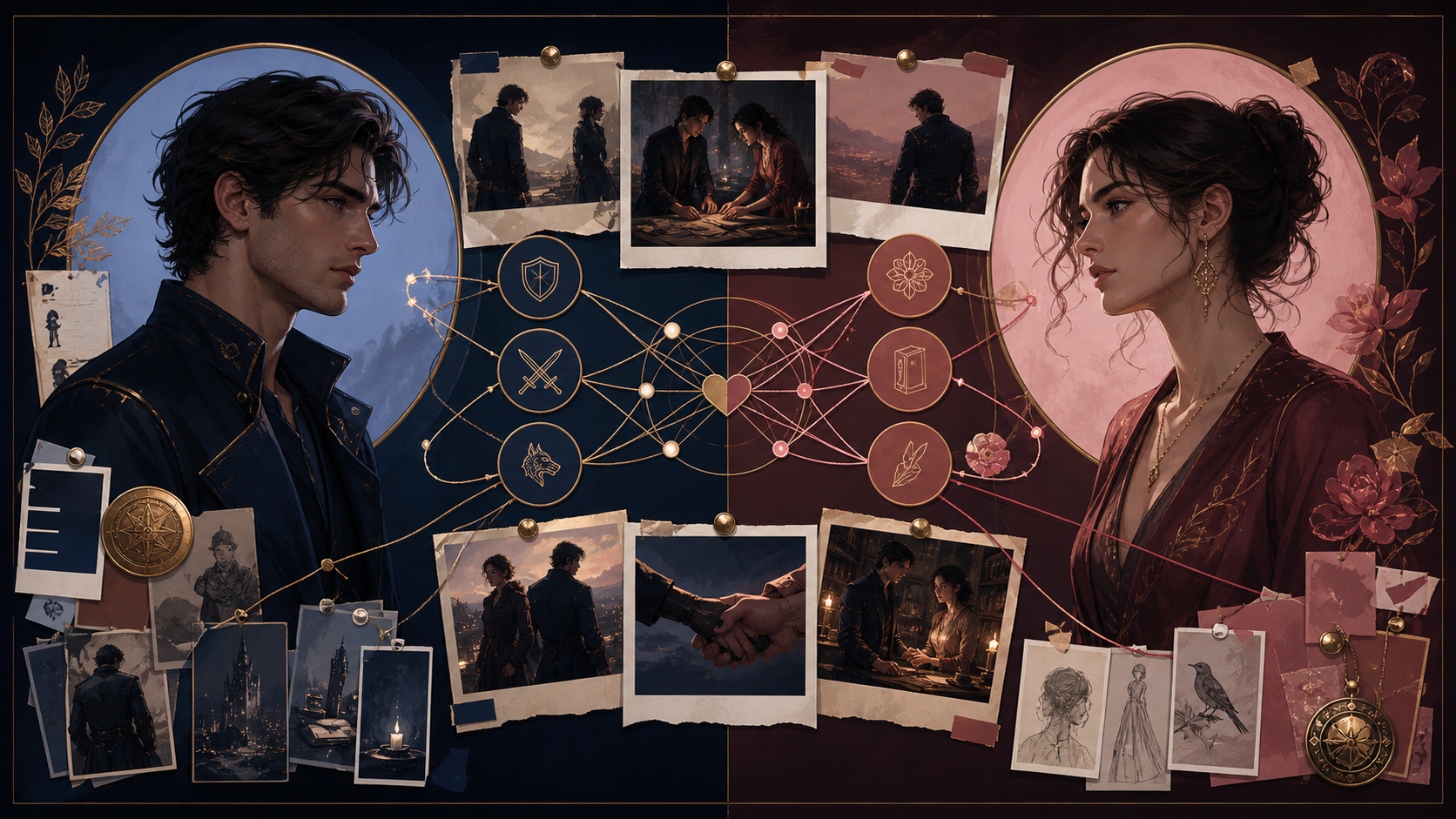
A good ship name does more than compress two names into one word. It gives a relationship a memorable label: something readers can recognize in a discussion, remember after a scene, and use consistently in a fandom tag. The strongest options usually balance three things at once—both characters remain identifiable, the result is easy to say, and the tone fits the pairing.
A ship name generator can quickly explore combinations that are difficult to see by hand, but the final judgment is still yours. This guide explains the main ways ship names are built, a repeatable process for evaluating them, and how to create names for canon characters, original characters, real couples, friends, rivals, and other memorable duos.
What is a ship name?
A ship name—also called a pairing name—is a short label used for two people or characters as a duo. In fandom, “ship” comes from “relationship,” but the label is not limited to canon romance. Fans may name a hoped-for romance, an established couple, a friendship, a rivalry, a self-ship, or an OC and canon-character pairing.
Many ship names are portmanteaus: parts of two names blended into one. Others use initials, separators such as “x” or “&,” meaningful words, abilities, visual motifs, roles, or private references. There is no single universal formula because fandom communities develop their own conventions. The practical goal is not to obey one rule; it is to make the intended pair recognizable without producing a name that is painful to read or say.
The five most useful ship-name structures
1. Prefix-and-suffix blend
The simplest method joins the beginning of one name to the ending of the other. Luna and Orion might become “Lunor,” while Emma and Olivia might produce “Emivia.” This works best when the join preserves a natural vowel-consonant rhythm.
Always try both directions. The first half of Character A plus the second half of Character B is only one candidate. Reversing the order changes the available sounds and may make both names more visible.
2. Syllable blend
Instead of cutting names at a fixed number of letters, split them where speakers naturally divide the sound. “Kael” and “Seraphina,” for example, could become “Kaelina” or “Serakael.” A syllable-based cut often sounds more intentional because it follows pronunciation rather than spelling.
This approach is especially useful for names with silent letters, unusual spellings, titles, or very different lengths. Say each original name aloud, mark the stressed syllable, and test whether that recognizable sound can survive the blend.
3. Overlap or pivot blend
Some names share a sound or letter sequence that can act as a hinge. If the end of one fragment and the beginning of another overlap, remove the repeated sound instead of stacking it twice. The result is usually shorter and smoother than a direct join.
Do not force an overlap just because the spelling matches. The transition also needs to work when spoken. A blend that looks clever but requires an explanation every time will struggle as a conversational nickname.
4. Initials and hybrid tags
When the names refuse to blend cleanly, clarity can beat novelty. Initials, full-name pairs, and compact tags such as “L/O,” “Luna x Orion,” or “Luna & Orion” keep both identities intact. The separator can also communicate context: “x” often suggests a romantic pairing, while “&” is commonly read as platonic or as a general duo label.
Check the convention of the platform or community where you plan to post. A format that is clear in personal notes may be ambiguous in a searchable archive, and an existing fandom may already distinguish romantic and platonic pair labels in a specific way.
5. Symbolic or relationship-based name
A ship name does not have to contain either personal name. “Moonbound,” “Wildspark,” or “Ink & Ember” can refer to shared imagery, opposing powers, a recurring scene, matching roles, or the emotional shape of the relationship. Symbolic names are particularly useful when the character names are hard to combine or when the fandom favors motif-based labels.
The tradeoff is discoverability. A symbolic name may sound excellent to established fans while giving a newcomer no clue who it represents. Use it when the reference is strong enough to be learned and repeated, or pair it with an explicit character tag in posts.
How to make a ship name step by step
Step 1: Write the names as they are pronounced
Start with sound, not typography. Break both names into spoken chunks and underline the syllable that carries the most identity. Nicknames may be more useful than formal names if that is what readers already recognize.
Step 2: Build a fragment bank
List two or three usable pieces from the beginning, middle, and end of each name. Include a phonetic spelling when the written form is misleading. This turns the task from one blind cut into a small set of deliberate building blocks.
Step 3: Combine in both directions
Generate candidates with A first and B second, then reverse the order. Try one short fragment with one long fragment, a shared-sound overlap, initials, and one symbolic option. Ten varied candidates are more useful than thirty versions made from the same cut.
Step 4: Read every candidate aloud
If you hesitate over pronunciation, other people probably will too. Remove repeated syllables, awkward consonant clusters, and accidental pauses. A slight spelling adjustment is acceptable when it preserves both source names and makes the intended pronunciation obvious.
Step 5: Check recognition and tone
Ask whether someone who knows the characters could reasonably recover both names. Then ask what the new word feels like. A soft, playful blend may suit a warm romance; a sharper name or symbolic phrase may fit rivals, dangerous allies, or an enemies-to-lovers dynamic.
Step 6: Test it as a label
Type the name as a hashtag, a story note, and a sentence: “I am writing a ___ scene.” Look for accidental words, confusing capitalization, unintended meanings, or a result that is already strongly associated with something unrelated. If the label will be public, search it before adopting it.
Step 7: Let usage decide
Do not wait for mathematical perfection. Keep two or three finalists, use them in context, and notice which one people remember without prompting. Ship names become durable through shared use, not because a formula proves that one arrangement is objectively correct.
A five-part test for a strong ship name
- Pronounceable: A reader can make a confident first attempt without stopping to decode the spelling.
- Recognizable: At least one distinctive sound from each character survives, or the symbolic reference clearly belongs to the pair.
- Memorable: The name has a clean rhythm, image, or contrast that is easier to retain than a random string of fragments.
- Searchable: It is not so generic that results disappear into an unrelated topic, and it works in the tag format you intend to use.
- Emotionally aligned: The sound or image fits the relationship rather than merely proving that two names can be merged.
A candidate does not need a perfect score in every category. An established fandom can teach people an unusual pronunciation, while a private couple nickname does not need global search visibility. The test helps you see the tradeoff you are making.
Ship name examples and what they demonstrate
The examples below use invented pairings so the construction method is easy to see. They are starting points, not claims of uniqueness.
- Luna + Orion → Lunor, Oriluna, Moonbound, L/O. “Lunor” is compact, “Oriluna” preserves more of both names, “Moonbound” uses shared celestial imagery, and “L/O” prioritizes clarity.
- Kael + Seraphina → Kaelina, Serakael, Emberwing. The first two use syllable fragments; the symbolic option could fit a fire-and-flight motif or a relationship that repeatedly returns to those images.
- Rowan + Ash → Rowash, Ashenrow, Wildspark. The direct blends keep name recognition, while “Wildspark” suggests a more energetic or volatile dynamic.
- Emma + Olivia → Emivia, Olivemma, E&O. Trying both directions reveals different rhythms. The initials remain a strong fallback if neither blend feels natural.
Notice that the “best” answer depends on use. A short tag, a private nickname, and the title of a relationship playlist may reasonably choose three different options for the same pair.
How relationship type changes the name
Romantic pairings
Romantic ship names often benefit from a single smooth word because it makes the pair feel unified. Cute, elegant, dramatic, or bittersweet styles can work, but the sound should reflect the relationship you actually write—not a generic idea of romance.
Friends and platonic duos
For a platonic bond, initials, “&” tags, team names, shared jokes, and adventure-based labels may be clearer than a romantic-sounding portmanteau. If your community uses separate conventions for romantic and platonic relationships, follow them so readers know what kind of content to expect.
Rivals and enemies-to-lovers
Contrast becomes useful here. Harder consonants, mirrored words, opposed elements, titles, and conflict motifs can preserve the friction that makes the pairing interesting. A name that sounds too harmonious may erase the very tension fans want to discuss.
OC pairings and self-ships
Original-character ships give you more freedom because there may be no established label to compete with. Use that freedom to connect the name to the characters’ world, abilities, shared history, or turning point. For an OC and canon character, retain enough of the canon character’s recognizable name or imagery that the pairing remains legible to fandom readers.
Real couples and private nicknames
A real couple name does not need to satisfy fandom tagging rules. Pronounceability, affection, and personal meaning can matter more than searchability. Keep the nickname consensual, and avoid putting sensitive personal details into a public generator or post.
Common ship-name mistakes
Using only one cutting formula
Automatically joining the first half of Name A to the second half of Name B misses syllable boundaries, reverse-order blends, overlaps, initials, and symbolic names. Vary the construction before deciding the names are impossible to combine.
Keeping every recognizable letter
Trying to preserve too much often creates a long, unpronounceable result. Recognition comes from distinctive sound patterns, not from squeezing every letter into one label.
Ignoring accidental meanings
A blend may form an existing word, slang term, brand, or phrase in another language. You do not need exhaustive linguistic research for a private nickname, but a quick search is sensible before publishing a tag or selling anything that uses the name.
Choosing a name that is too generic
A beautiful word such as “Fire” or “Stars” may fit the pair but be nearly impossible to search. Add a more distinctive second element, or use the symbolic label beside explicit character names.
Treating a generated option as official
A generator can suggest possibilities; it cannot declare a fandom consensus, confirm canon, guarantee originality, or grant ownership. Check established community usage and treat the result as a creative proposal.
Ship name generator vs. a basic name combiner
A basic name combiner usually applies letter or syllable rules to two inputs. That is useful for quickly exploring portmanteaus, but it knows little about why the characters belong together. A context-aware ship name generator can also consider relationship type, character details, fandom, desired style, themes, and words you want to avoid.
Context does not remove the need for editing. Generated language can miss pronunciation, invent a weak connection, repeat an existing label, or produce a word with an unintended association. Use generation to widen the candidate pool, then apply the five-part test and your knowledge of the characters.
How to use the Headcanon Ship Name Generator
Headcanon’s Ship Name Generator starts with two required names and lets you add the context that a mechanical blend would miss. The current form supports character details, relationship type, fandom or universe, multiple naming styles, themes, words to avoid, and additional instructions.
- Enter both names. Use the versions readers recognize, including a common nickname when it matters more than a formal name.
- Add only useful context. A defining trait, power, shared motif, or relationship tension is more valuable than a complete biography.
- Choose styles intentionally. Select the moods and structures that fit the pairing instead of asking for every possible tone.
- Use themes and exclusions. Advanced options can steer the result toward important imagery and away from words or associations you do not want.
- Generate and compare groups. The tool currently returns ten suggestions organized as Best Matches, Creative Names, and Short & Tag-Friendly options, with a short explanation for each.
- Copy finalists, not just the first result. Read several aloud, search public candidates, and test them in the sentence or tag where they will appear.
The interface shows the applicable generation access and credit information. Do not enter confidential personal information. Results are creative suggestions and are not guaranteed to be unique, unused, official, or legally available for commercial branding.
What to do after you choose a ship name
A label is most useful when it leads back to the relationship itself. Once you have a finalist, define what makes the pair worth naming: the trust they have earned, the argument they cannot resolve, the behavior only they notice, and the future question keeping them in motion.
- Use the Relationship Headcanon Generator to explore habits, boundaries, tension, and emotional patterns.
- Use the Incorrect Quotes Generator to test whether the pair has a recognizable conversational rhythm.
- Use the Scenario Headcanon Generator to place the relationship under a specific kind of pressure.
- Read the duo relationships guide to develop chemistry, conflict, trust, and shared history after the naming stage.
Frequently asked questions
How do you combine two names to make a ship name?
Break both names into pronounceable fragments, combine the fragments in both directions, and test syllable blends, shared-sound overlaps, initials, and symbolic alternatives. Read each candidate aloud and keep the options that preserve recognition without awkward pronunciation.
Can a ship name be for a non-romantic relationship?
Yes. People also create labels for friendships, rivalries, creative partners, teams, and other duos. Use wording and separators that make the intended relationship clear in the community where you post.
Can I use a ship name generator for original characters?
Yes. OC pairings are a strong use case because character details, powers, worldbuilding, and shared motifs can inspire both blended and symbolic names. Include the few details that define the relationship rather than pasting an entire character profile.
Should a ship name include both character names?
Not necessarily. A portmanteau makes identification easier, but symbolic names, initials, role combinations, and full-name tags can work. If the label does not contain either name, use explicit character tags nearby until the meaning is established.
How long should a ship name be?
There is no fixed limit. One short word is convenient for conversation and tags, but clarity matters more than removing every extra syllable. If shortening the name makes one character disappear, use a longer blend or a hybrid tag.
Does a generated ship name belong only to me?
No exclusivity should be assumed. Different people and tools can independently produce the same combination, especially from common names. Search before public or commercial use, and do not treat a generated suggestion as proof of trademark or username availability.
Can I use generated ship names in fanfiction?
You can use a suggestion as a pairing label in your creative workflow, but follow the rules of the archive, platform, event, or fandom community where you publish. A ship name does not change the ownership or status of the underlying characters and source material.
Create a name the relationship can grow into
The most effective ship name is not always the cleverest blend on the page. It is the one people can say, recognize, remember, and connect to the dynamic between the characters. Start with sounds, explore more than one structure, test the name in context, and let actual use reveal the winner.
When you are ready to compare ten context-aware ideas, open the Ship Name Generator and give the pairing a name that sounds like it belongs to them.