
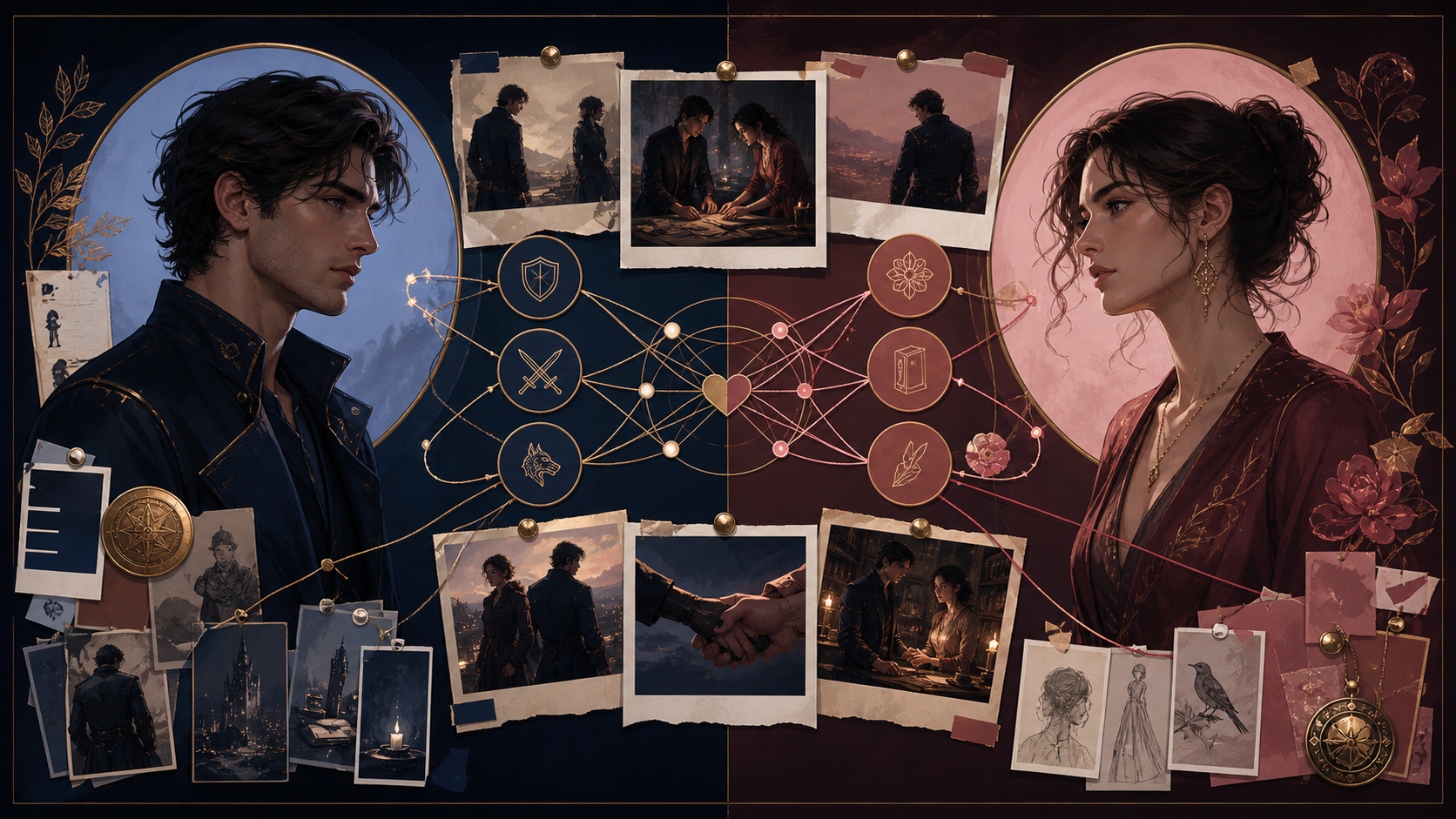
A duo relationship becomes distinctive when both characters change the range of choices available to the other. Labels such as friends, rivals, siblings, partners, or enemies describe the category; they do not explain the dynamic.
Define what the relationship does
Complete two sentences: “When these characters are together, they can…” and “When these characters are together, they cannot avoid…” The first identifies capability; the second identifies pressure.
“Mara and Iven can cross routes neither would attempt alone. They cannot avoid arguing about whether trust should be earned through proof or granted before proof is possible.”
Write chemistry beyond attraction
- Attention: what does each person notice before anyone else?
- Rhythm: who initiates, interrupts, repairs, withdraws, or changes the subject?
- Permission: what behavior does one allow only around the other?
- Misreading: which protective act is repeatedly interpreted as control, pity, or rejection?
Give conflict two defensible positions
Conflict lasts when both strategies protect something real. Mara values evidence because promises failed her; Iven values provisional trust because no system can prove safety in advance. The argument is not solved by deciding that one person is irrational.
Track trust as behavior
Instead of a single trust score, record what each person will share, delegate, risk, forgive, and ask for. Trust can grow in one area while shrinking in another.
Use a three-scene test
- Routine: show the relationship when nothing is wrong.
- Pressure: remove the habit that normally keeps them comfortable.
- Repair: show what each person does after harm, not only what they say.
Write repair as a sequence
Repair is not the same as immediate forgiveness. First, one person must identify what happened without minimizing it. Next, the harmed person needs space to define the impact. Finally, the relationship needs a changed behavior that can be observed later.
If Mara withholds route information and endangers Iven, an apology matters, but the next mission tests it. Giving him the full map before he asks demonstrates change. Iven may still refuse the mission; the repair remains meaningful because it restores choice rather than demanding closeness.
Track the relationship through stages
- Baseline: the habit that makes the pair recognizable.
- Strain: the old habit no longer protects both people.
- Rupture: a choice changes what one person is willing to risk or share.
- Repair or separation: the pair establishes a new pattern, which may include distance.
Account for power and permission
A relationship can feel warm while still containing unequal authority, knowledge, money, status, age, physical power, or social support. Name what one person can safely refuse and what consequence follows. Consent and boundaries matter in friendship, family, rivalry, mentorship, and partnership—not only romance.
If Iven controls portal access, Mara agreeing to travel with him is not enough by itself. The scene should show whether she can question the route, leave, inspect the record, or choose another courier. Giving both characters meaningful options keeps trust from becoming obedience.
Give the pair a relationship-specific ritual
Choose a repeated behavior that could not be transferred unchanged to another pair: how they end an argument, exchange responsibility, signal that a joke went too far, or ask for company. Then break the ritual once. Their response reveals whether the relationship can adapt.
Save the dynamic, not every conversation
In OC Studio, a duo record should preserve the relationship function, shared history, conflict pattern, trust boundaries, and change. Use the relationship network guide when the pair’s choices begin affecting the wider cast.