
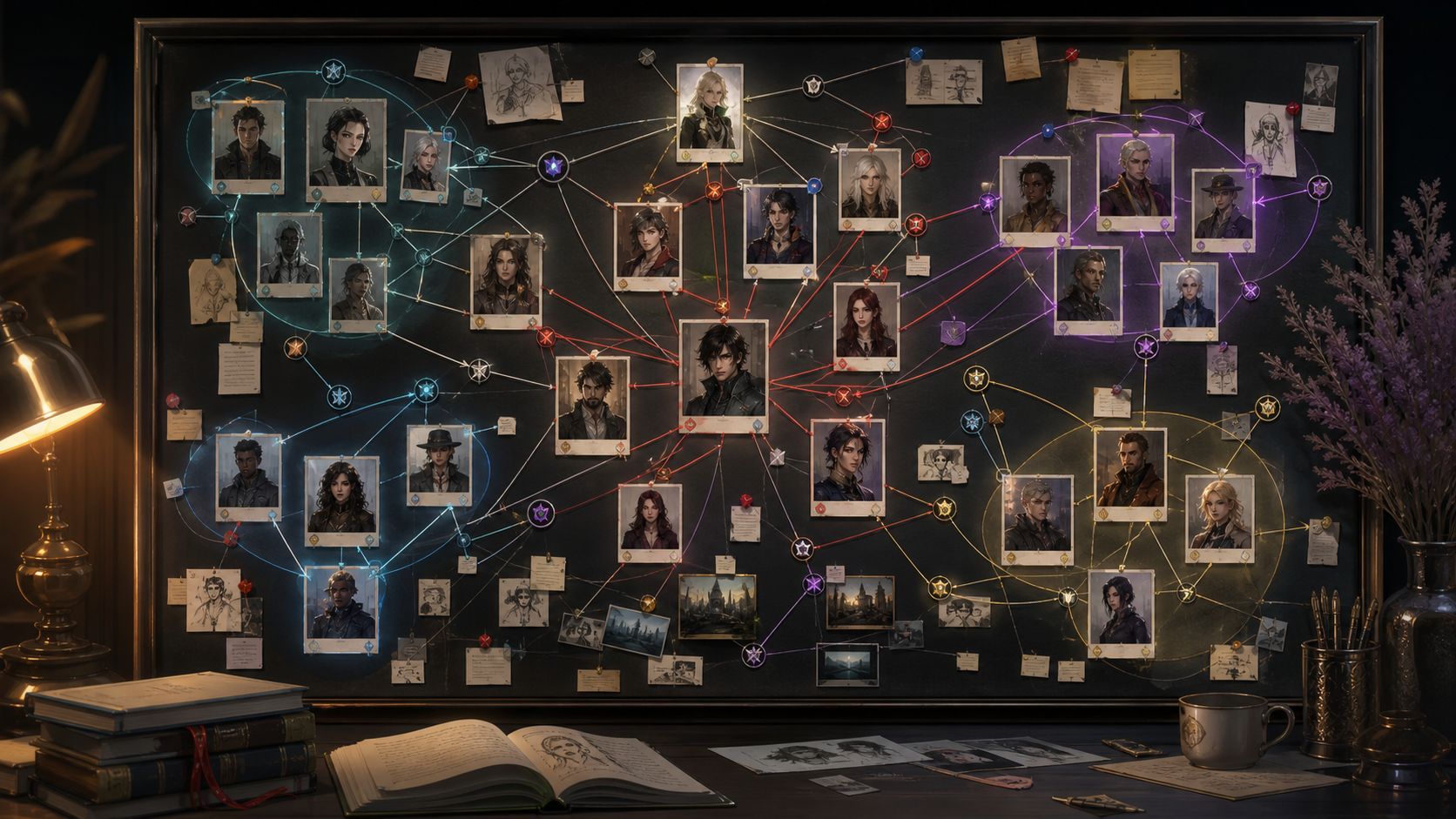
A relationship network is more than a diagram of who knows whom. It records how trust, obligation, information, affection, fear, and power move through a cast. The network becomes useful when changing one connection produces consequences somewhere else.
Start with asymmetric relationships
Two people rarely describe the same bond in the same way. Mara considers Iven a necessary expert; Iven considers Mara the first person who treats portal failures as evidence rather than incompetence. Record both perspectives.
Give every major edge a story function
- Access: this person controls information, places, resources, or introductions.
- Pressure: this person challenges a belief or demands a cost.
- Witness: this person sees a side of the character others miss.
- Change: this relationship can break, deepen, reverse, or expose another connection.
Use factions without flattening individuals
A faction needs a shared interest, not a shared personality. Add at least one internal disagreement about methods, risk, or priorities. That disagreement creates alliances across group boundaries and prevents the network from becoming two uniform teams.
Map information separately from affection
The person a character loves may not be the person they trust with a secret. Track who knows a fact, who suspects it, who can verify it, and who benefits from silence. Information flow often generates cleaner plot movement than adding another villain.
Run the removal test
Temporarily remove one character from the map. If nothing changes, that relationship may be decorative. If routes close, secrets become safer, or two rivals must cooperate, the connection has structural value.
Worked chain reaction
Mara shares evidence with Iven but not with Tali. Iven asks a portal inspector to verify it. The inspector warns the courier guild, which assumes Tali already knows. Tali learns that everyone protected her by excluding her and accepts help from Mara’s rival instead.
No new antagonist was required. One asymmetric information choice altered four relationships and created the next scene. When mapping a network, write the likely second-order effect beside every major secret, alliance, or rupture.
Keep the map readable
Do not record every acquaintance. Include relationships that control access, create pressure, witness change, or carry information. Use a short status such as stable, strained, hidden, one-sided, or broken, but support the label with a sentence describing current behavior.
Review the network after each major arc beat. Remove connections that never affect a choice and add a date or story milestone to changed relationships so older assumptions do not quietly return.
Annotate change instead of drawing more lines
A useful map can remain small if each important connection records direction, current status, hidden information, and the next likely pressure. Use notes such as “Mara trusts Iven with evidence; Iven does not trust Mara with timing” rather than a single mutual-trust label.
When a relationship changes, keep the previous state with the scene or milestone that caused the change. This makes reversals understandable and prevents the map from presenting the ending relationship as if it had always existed.
Connect the map to scenes
- Choose one relationship that changes this chapter.
- Identify two other people affected by that change.
- Decide who learns the change first and who learns it incorrectly.
- Create a scene where the misinformation alters a choice.
Build focused pair dynamics with the duo relationship guide, then use story arcs to decide when the wider network changes.