
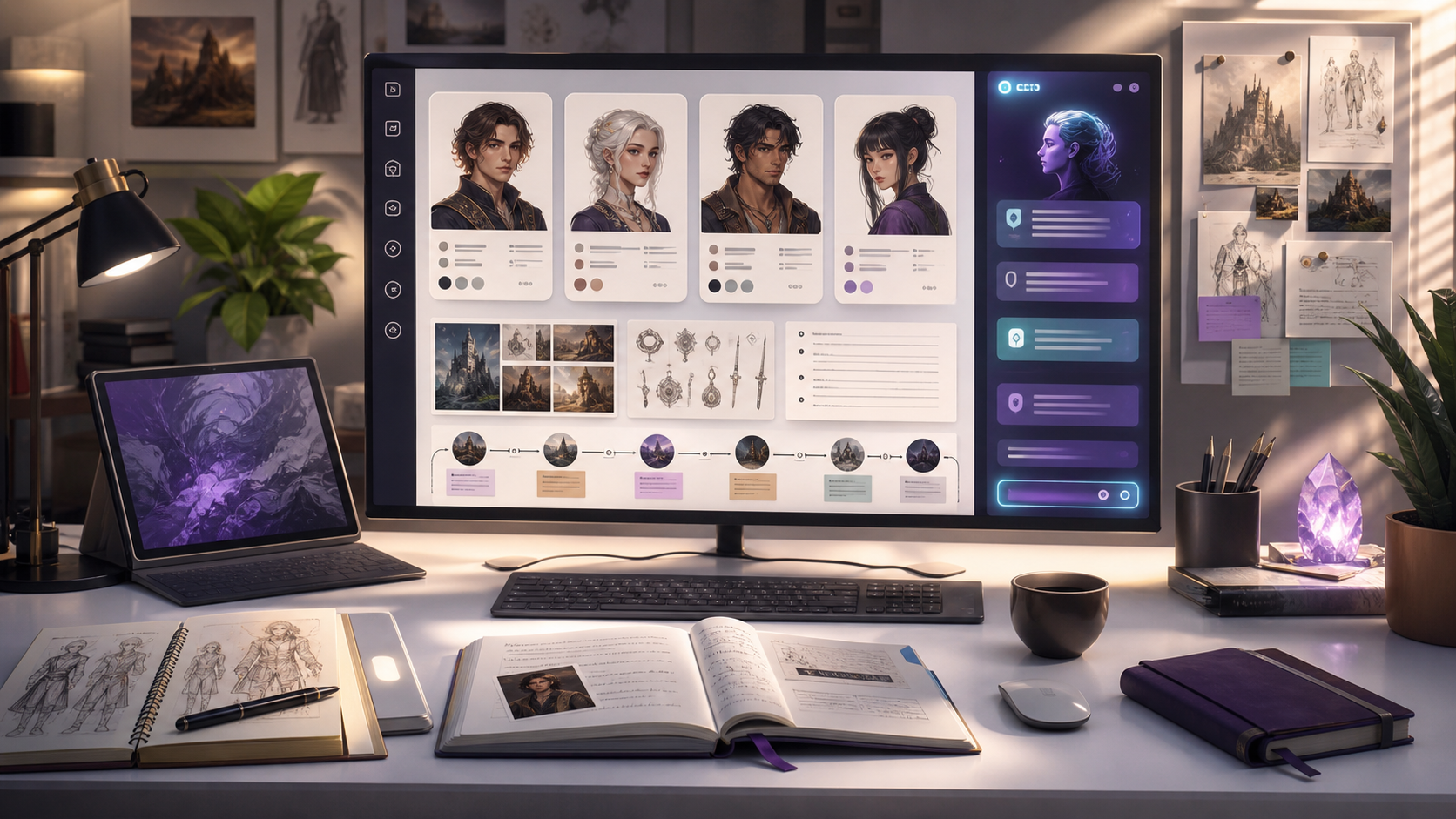
OC Studio is a structured workspace for developing original characters across connected records: character profiles, main and sub-worlds, duo relationships, relationship networks, and story arcs. Its value is not the number of fields you fill. The value is keeping one creative decision visible when you make the next one.
A worked example: Mara, a courier who refuses shortcuts
Start with a compact character core: Mara carries messages between floating settlements. She is reliable because she believes one delayed message caused her brother’s disappearance. She refuses magical shortcuts, even when ordinary travel puts her at greater risk.
That core already contains a role, strength, wound, false belief, and contradiction. Every later record should pressure one of those elements rather than inventing unrelated lore.
Step 1: Build the character profile
- Goal: find proof that her brother reached the northern settlements.
- Fear: trusting a shortcut means surrendering control over who receives the message.
- Voice: precise route language; emotional statements become logistical observations.
- Continuity marker: she checks seals twice and never promises an arrival time she cannot defend.
Step 2: Make the world create pressure
The main world uses unstable sky routes and licensed portals. The important detail is not how every portal works; it is that portal access is controlled by the institution Mara distrusts. A sub-world record for the northern settlement can then capture local weather, customs, and the political reason messages disappear there.
Step 3: Add relationships with different functions
A duo relationship with a portal engineer tests Mara’s refusal to use shortcuts. A separate relationship with a younger courier tests her need for control. In the relationship network, those two people should not merely connect to Mara—they should have competing interests that continue when she leaves the room.
Step 4: Turn the records into an arc
- Setup: Mara accepts a message addressed in her brother’s handwriting.
- Pressure: the safe route closes, leaving only a licensed portal.
- Turning point: the engineer reveals that the missing messages were diverted by policy, not magic.
- Choice: Mara must trust another person with the message while she exposes the system.
- Change: reliability stops meaning “do everything alone.”
What to leave blank
Do not complete a field only because it exists. Leave geography, factions, secondary relationships, and late-arc beats blank until they affect a decision. A smaller connected project is more useful than a complete-looking archive full of facts the story never uses.
A continuity review before drafting
- Does the world pressure the character’s belief?
- Does each important relationship reveal a different side of the character?
- Does the turning point require a choice rather than an accident?
- Can you trace the ending change back to the starting contradiction?
Before and after: why connected records matter
Before: Mara is reliable, the world has portals, Iven is an engineer, and the plot contains a missing message. Each fact could belong to a different story because none changes the others.
After: Mara’s definition of reliability makes her avoid portals; portal records explain why messages disappear; Iven controls access to those records; and the missing message forces Mara to choose whether reliability can include delegation. The same four facts now form a usable story engine.
Maintain the project as the story changes
After drafting a major scene, update only the records that changed. If Mara delegates the delivery, revise her current belief and the relevant relationship boundary. If the portal law is exposed, update the world rule and any later arc beat that depended on secrecy. This keeps the project useful without turning maintenance into a second writing job.
Create a short “current truth” note before each drafting session: what the character wants now, what each key relationship knows, and which world rule is active. Archive old ideas instead of silently mixing them with the current version.
Open OC Studio to create a project, or continue with the focused guides to worldbuilding, relationship networks, and story arcs.