
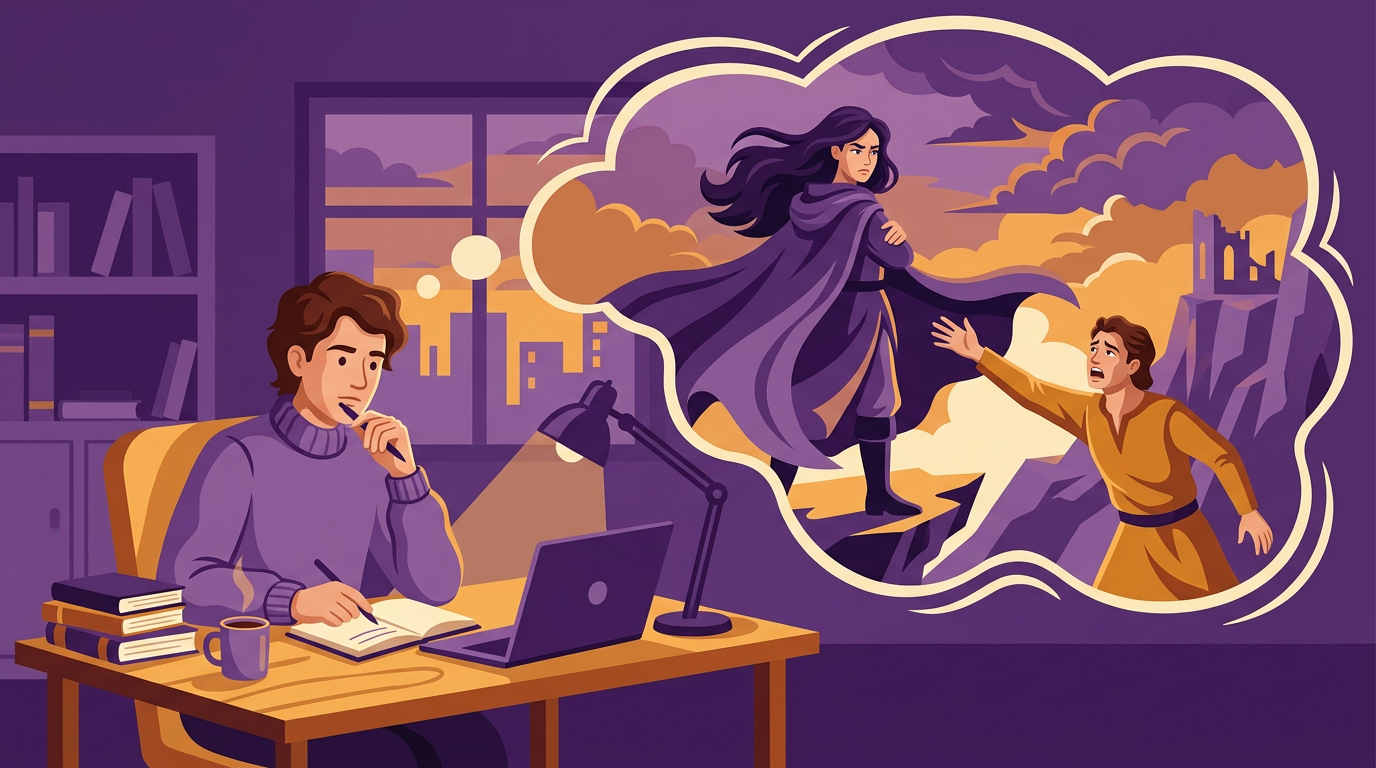
If character headcanons answer 'who is this person,' scenario headcanons answer 'who is this person when something happens.' The scenario format is how fan creativity gets specific — instead of 'he's secretly caring,' you write the moment when his care becomes visible, the exact situation where the mask slips.
Scenario headcanons are the bridge between a character headcanon and fan fiction. They're a scene without a story — a moment with weight, a specific beat that reveals something true.
What Is a Scenario Headcanon?
A scenario headcanon places one or more characters in a specific situation — usually one that doesn't appear in canon — and imagines how they would respond. The scenario is the pressure test for everything you believe about who these characters are.
Scenario headcanons can be short (a single reaction beat) or extended (a full sequence of events). They can be lighthearted or devastating, romantic or platonic, canon-adjacent or completely AU. What makes them scenario headcanons rather than fan fiction is usually brevity: they're about the moment, not the story around it.
Common Scenario Headcanon Formats
The First Meeting Scenario
What if these two characters met for the first time differently? Earlier, later, in different circumstances, without knowing who the other was? First meeting scenarios are popular because they force you to strip away all the accumulated history and see the characters as they would be to each other before they know what they'll become.
The best first meeting scenarios use the characters' established traits to make the meeting feel both surprising and inevitable: of course this is how they would react to this specific person, even not knowing anything yet.
The Crisis Scenario
A character's true nature shows under pressure. Crisis scenarios — emergencies, confrontations, moments of real danger or grief — are useful in fan creativity because they strip away social performance and show what's underneath.
- What does this character do when someone they care about is hurt?
- How do they behave when they're genuinely afraid vs. when they're performing fear?
- What's their instinct in a situation with no good options?
The Hurt/Comfort Scenario
One of the most enduringly popular scenario types across all fandoms. One character is vulnerable — physically hurt, emotionally broken, exhausted beyond their usual defenses — and another character responds. The scenario is about the relationship revealed in that response.
What makes hurt/comfort scenarios great: the comfort character's response should be specific to them. Not generic comfort, but the particular way this person expresses care — which should tell us as much about them as about the person they're comforting.
The Mundane Revelation Scenario
Small, ordinary situations that reveal something true about a character. Grocery shopping. A bad day at work. A conversation on public transit. A character ordering food. Mundane revelation scenarios are beloved because they humanize epic characters — showing that the same person who faced world-ending threats also has opinions about how to load a dishwasher.
The What-Would-You-Do Scenario
These scenarios present a character with a moral or practical dilemma and explore how they'd respond: 'what does Character X do if they overhear someone saying something terrible?' 'what would Character Y do if they found a lost child?' The scenario is a character portrait through action rather than description.
What Makes a Scenario Headcanon Work
The same thing that makes any headcanon work: specificity grounded in character. But scenario headcanons have an additional requirement — they need to be scenarios where the character's specific traits actually matter.
- Choose a scenario that creates pressure on this character's specific tensions — not a generic difficult situation, but one that's difficult because of who this person is
- Let the character respond in a way that's true to them, even if it's not the heroic or optimal response — realism reveals character better than wish fulfillment
- End on something specific — a concrete detail, a line of dialogue, an action — rather than a general description of feeling
- Avoid having the character resolve the scenario too neatly — the most resonant scenario headcanons often leave the tension intact rather than solving it
Scenario Headcanons vs. Other Headcanon Types
Understanding how scenario headcanons differ from other formats helps you choose the right tool for what you want to explore:
- Character headcanons describe a trait; scenario headcanons demonstrate it in action
- Relationship headcanons describe a dynamic; scenario headcanons show that dynamic under pressure
- AU headcanons change the world; scenario headcanons change the situation within the world
- Fan fiction narrates a complete story; scenario headcanons capture a single revealing moment
Using the Scenario Headcanon Generator
The scenario headcanon generator on Headcanon.io is designed specifically to generate these situational character moments. The key is specificity in your input: instead of 'generate a Naruto scenario,' try 'generate a scenario where Sasuke has to ask someone for help and can't avoid it.' The more specific the constraint, the more specific and character-revealing the output.
You can also combine the scenario generator with the relationship headcanon generator for two-character scenarios — drop them into a specific situation together and see how their dynamic plays out under that pressure.
Frequently Asked Questions About Scenario Headcanons
What is a scenario headcanon?
A scenario headcanon is a fan-created idea that places a character in a specific situation — one not shown in canon — and imagines how they would respond. It's a way of exploring character through action and reaction rather than description.
What's the difference between a scenario headcanon and fan fiction?
Scenario headcanons are typically brief and focused on a single moment — they're the seed of a story rather than the story itself. Fan fiction builds a full narrative arc around a premise. Many fan fiction stories begin as scenario headcanons that the writer wanted to fully dramatize.
How do I come up with good scenario headcanon ideas?
The best scenario headcanon ideas come from asking: 'what situation would most challenge this specific character?' Find the tension that's already in who they are — the contradiction between what they want and what they can bring themselves to do — and build the scenario around it.