
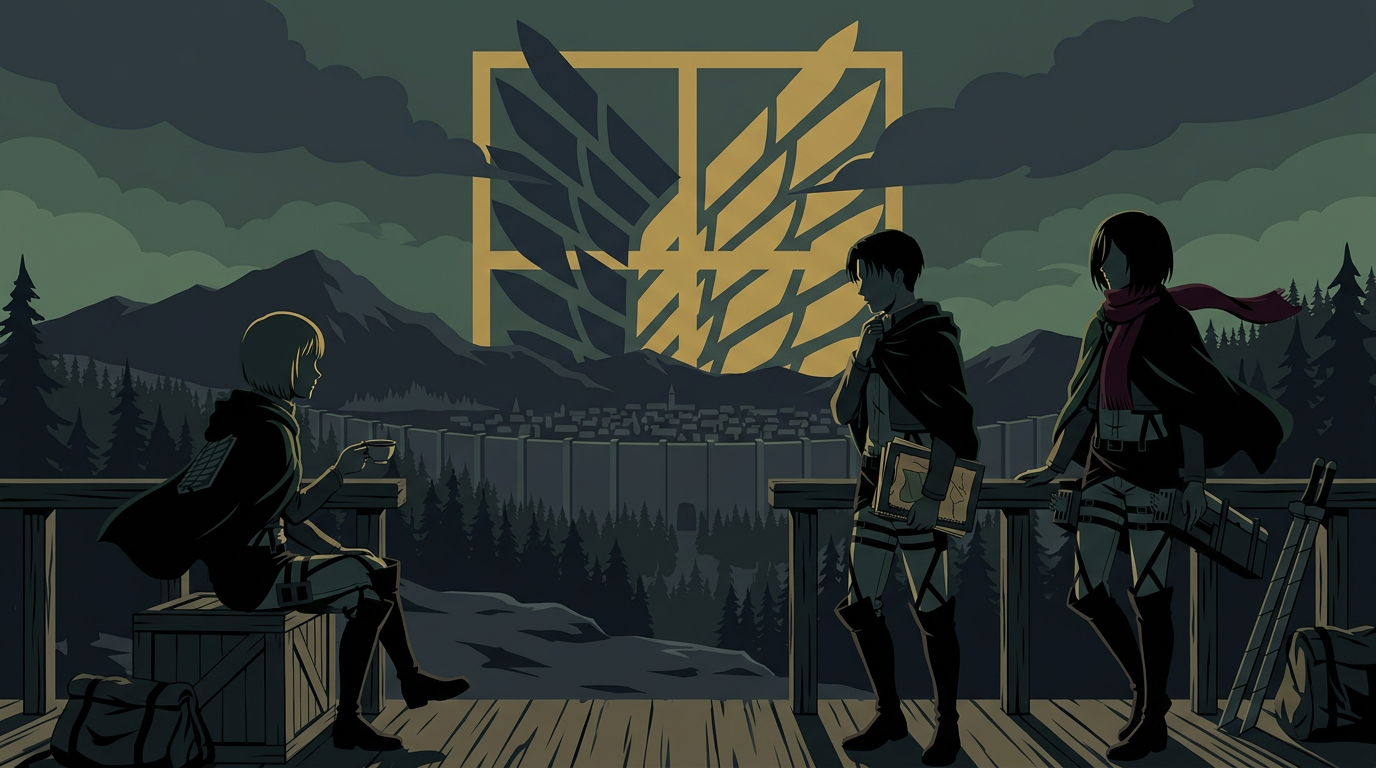
Attack on Titan's ending is one of the most discussed in anime history — praised, criticized, and mourned in equal measure. For many fans, headcanons have become a way of processing it: imagining alternate timelines, exploring character moments the manga never showed, or simply refusing to accept some of what happened.
Whether you're post-canon grieving, canon-divergence hoping, or deeply invested in the interior lives of characters the series didn't have time to fully explore — AOT headcanon culture has something for everyone.
Why AOT Produces Such Intense Headcanon Culture
Attack on Titan is unusual among major anime fandoms in that the emotional weight tends to fall on secondary characters. Armin, Mikasa, Hange, Levi, Historia, Reiner, Bertholdt — fans are as invested in them as in Eren, often more so.
This creates a headcanon landscape broader than most fandoms: rich creative communities exist around almost every named character, not just the protagonist. The tragedy and moral complexity of the story also make headcanons feel necessary rather than optional — fans need somewhere to put what the text made them feel.
Popular Headcanons by Character
Levi Ackerman
Levi is the most headcanoned character in the AOT fandom — partly because his backstory is rich but deliberately sparse in canon, and partly because his emotional presentation — controlled, precise, cutting — is a goldmine for 'what's beneath the surface' headcanons.
- He maintains his obsessive cleanliness not from preference but from trauma — the Underground taught him that dirt and disease were existential threats, and the habit never left him
- He reads the names of every soldier he has lost — not the lists, but each name individually, on the anniversary of their death
- He's far less blind to his own emotions than he appears; he simply chooses not to let them interrupt what needs doing
- His relationship with tea is one of the few things he allows himself to care about without justification
Hange Zoe
Hange headcanons tend to run in two directions: the chaos of their enthusiasm, and the quiet tragedy beneath it. The fandom has spent years exploring what happens in the gap between Hange's public energy and their private moments.
- Their obsession with Titans began as a way to make meaning out of a senseless world — understanding the monster is the only way to survive it
- They sleep badly and always have, but are extremely protective of other people's rest
- They're meticulous record-keepers — everything goes in the notebooks, including things that will never be shared with anyone
Eren Yeager
Eren headcanons are among the most contested in the fandom, because his character arc is itself one of the most contested in anime. Headcanon communities split along those who explore Eren as tragic and determined, those who explore him as broken by foreknowledge, and those who write alternate-timeline versions where different choices were made.
- Early-arc Eren headcanons often focus on his relationship with freedom as a concept versus freedom as a reality — what he thought he wanted versus what he was actually seeking
- Post-timeskip headcanons frequently explore the weight of knowing the future, and whether knowing it changes anything
- Canon divergence headcanons — what if Eren had chosen differently — are among the most popular long-form fan fiction in the fandom
Mikasa Ackerman
Mikasa's post-canon trajectory generated as much discussion as Eren's arc itself. Headcanons about her life after the final chapter are some of the most emotionally resonant in the fandom.
- She carries the red scarf her whole life — not as grief, but as a choice she made and stands by
- She eventually finds a life she chooses, organized around her own desires rather than protecting someone else
- She and Armin write to each other for decades — their correspondence is how each of them processes everything they survived
Ships and Relationship Headcanons in AOT
EreHisu (Eren x Historia)
One of the most fascinating ships in AOT headcanon culture because of what the manga implied without confirming. Headcanons here tend to be complicated and politically aware — two people who love each other and are both caught in systems larger than either of them.
RivaHan (Levi x Hange)
The most popular ship in the AOT fandom, with a headcanon culture spanning domestic, dark, post-canon hopeful, and everything between. The appeal: two people defined by loss who found something like steadiness in each other.
Post-Canon and Canon Divergence Headcanons
Post-canon headcanons — what happens after the final chapter — are AOT's most distinctive contribution to fan creativity. The manga's ending left many character futures open or unresolved, and fans have built rich alternative futures in that space.
Canon divergence is equally popular: the AOT story has multiple moments where a different choice could have changed everything. Each of these is a whole creative universe in the fandom.
Creating AOT Headcanons with AI Tools
AOT's moral complexity makes it one of the more challenging fandoms for headcanon generation. For AI-generated content, the character headcanon generator works best when you specify the arc or period you're exploring — early-series Eren versus post-timeskip Eren produce very different results.
You can also explore AOT characters through the fandom headcanon pages on Headcanon.io, which curate character-specific insights, common fan interpretations, and generation prompts built around the AOT universe.
Frequently Asked Questions About AOT Headcanons
What are the most popular Attack on Titan headcanons?
Levi's grief practices, Hange's hidden vulnerability, the Survey Corps as found family, and Mikasa's post-canon life are among the most widely shared headcanons in the AOT fandom. Post-canon and canon divergence content is particularly active following the manga's conclusion.
Is AOT headcanon culture different from other anime fandoms?
Yes — AOT headcanon culture tends to be more politically and morally complex than most anime fandoms, reflecting the source material's themes. It also has a strong tradition of canon divergence and post-canon writing, partly as a response to the controversial ending.
Where can I find AOT headcanons?
Tumblr has the richest long-form headcanon community for AOT. Reddit's r/ShingekiNoKyojin has regular headcanon threads. AO3 hosts the largest collection of AOT fan fiction, including AU and canon divergence work.