
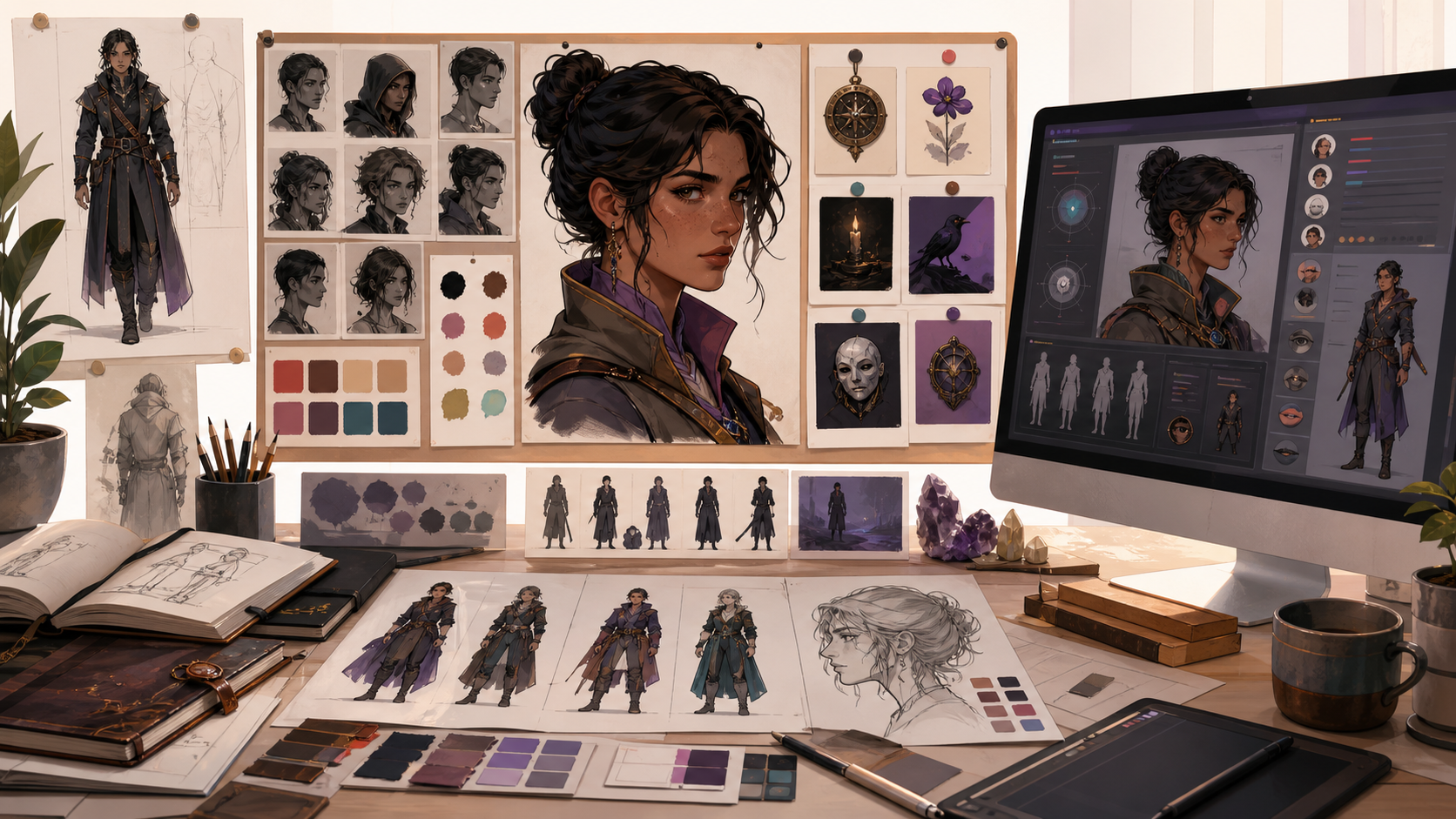
A memorable original character is not a collection of attractive traits. It is a person-shaped system: they want something, use a familiar strategy to pursue it, protect a belief, and create consequences when that strategy stops working.
Write the character core in one sentence
“Mara is a reliable courier who believes control prevents loss, so she refuses help even when cooperation is the only safe route forward.”
The sentence includes a role, strength, belief, behavior, and built-in conflict. If a new trait does not reinforce or complicate that core, it may not belong in the first draft.
Turn traits into evidence
Replace “loyal, anxious, clever” with decisions a reader can observe. Loyalty may mean keeping an inconvenient promise. Anxiety may appear as over-preparation. Cleverness may solve one problem while creating distrust because the character withholds the plan.
Give the character a voice system
- What do they name precisely?
- What emotion do they translate into jokes, facts, orders, or silence?
- When do their sentences become shorter or more formal?
- Which metaphor comes from their work, culture, or childhood?
Use visual design as story information
Choose a small number of stable visual anchors and explain their history or function. A repaired coat can signal scarcity, attachment, resistance to change, or professional pride. The same coat means nothing if it is included only because the color palette looks good.
Create relationships that challenge different parts
One person should reward the character’s familiar strategy; another should expose its cost. Mara’s younger courier admires her independence, while the portal engineer recognizes it as fear. Neither relationship exists only to deliver praise or romance.
Run a continuity check
- Does the backstory explain a belief without excusing every action?
- Do skills have limits, learning history, and consequences?
- Do visual details remain stable unless the story changes them?
- Does the character make at least one decision that cannot be replaced by plot coincidence?
Test the design in three incompatible situations
Write a short response to praise, public failure, and an offer of help. If the character behaves identically in all three, the profile may describe a pose rather than a decision-making system. Mara deflects praise with logistics, responds to failure by taking on more control, and treats help as a negotiation over responsibility. The reactions differ while expressing the same core belief.
Revise without replacing the character
When a design feels flat, do not solve it by adding another secret, power, or tragedy. Change the relationship between existing elements. A strength may be admired by one person and feared by another. A visual anchor may become inconvenient. A goal may remain stable while the acceptable method changes.
Keep a short revision log: what changed, why it changed, and which scenes or records are now inconsistent. This is especially useful when an OC appears across roleplay sessions, illustrations, or a long project where older versions remain visible.
Move from profile to story
A profile is complete enough when it helps you predict a difficult choice. Use the Character Profile guide to organize the stable information, then connect it to world pressure and a story arc.